Yippee ki-yay Christmas? by Rachel Wagner
Hans: “Do you really think you have a chance against us, Mr. Cowboy?”
McClane: “Yippee ki-yay, mother fucker.”
Die Hard (1988) is increasingly viewed as a “Christmas movie” alongside more typical choices like A Christmas Story (1983), Elf (2003), and Scrooged (1988). Die Hard is set on Christmas Eve and most of the action takes place during a Christmas party in downtown L.A.. The film features Christmas music, plenty of tinsel, a huge tree, fancy clothes, champagne—as well as terrorists, machine guns, and lots of explosions. There’s an entire website devoted to arguing that Die Hard should be part of American Christmas celebrations. I want to argue otherwise. Despite Die Hard’s Christmas setting, I fear the taboo amusement it brings is more indicative of America’s love affair with guns than core values like family or friendship. Call me a sourpuss if you like, but I get nervous when explosions become part of holiday rituals.
Director John McTiernan says in a 2020 interview that Die Hard was intended to be a “terrorist movie” about “horrible leftist terrorists who come into…the Valhalla of capitalism, Los Angeles, and they bring their guns and their evil ways and they shoot up people just celebrating Christmas…It was really about the stern face of authority stepping in to put things right again…[But] I didn’t want to make that movie.” Instead, he wanted to make a film that would be critical of capitalism. Drawing on the first script’s Christmas setting, he wanted to craft a main character more like George Bailey of It’s a Wonderful Life (1946). McTiernan was inspired by the scenes that take place in Pottersville, the fictional town in the alternate history in which George fails to stop the “evil banker” Mr. Potter. This sequence is “the clearest…criticism of runaway unregulated cowboy capitalism that’s ever [been] done in an American movie.” Cowboy capitalism is rogue capitalism, uncontrolled and bad for those on the receiving end of its bite. It’s a bit ironic then that McTiernan imagined his main character in Die Hard as a kind of “cowboy” too—just one who saves the day from both runaway capitalism and socialist-inspired terrorists. Everyone but John McClane, the urban cowboy, wants money. John just wants to be with his kids on Christmas, and using his gun judiciously is how he’s going to get there. Seeing guns as the means to a solid family life is as American as pumpkin pie.
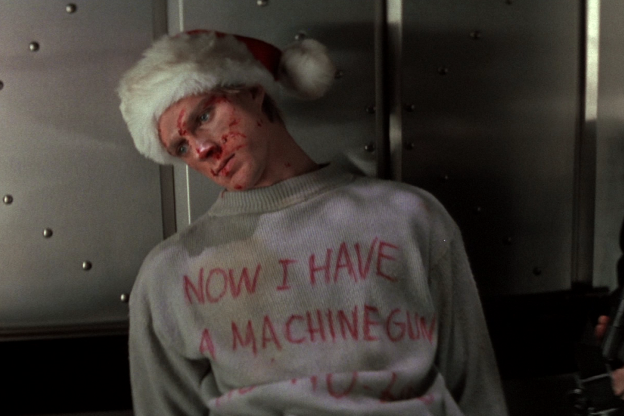
One of my objections to Die Hard’s cult status is the film wears poorly for its gauche eighties stereotypes. McClane, played by a smirking Bruce Willis, is a white cop. Holly, his white wife, needs her man to save her all by himself. Paulina, the McClanes’ Latina domestic helper, is happy to serve the family even on Christmas Eve. The limo driver is a Black man named Argyle who asks McClane for guidance in doing his job. Holly’s boss is an Asian businessman who is “greedy” in business. The terrorists are German members of a Nazi-adjacent fictional group called the “Radical German Volksfrei Movement,” though all they really want is to steal a lot of money.
The terrorists burst into a business office party while “Ode to Joy” is playing. The lead villain is Hans Gruber—apparently named after the villain in Our Man Flint (1966), a James Bond spoof. Played by Alan Rickman, whose terrible German accent comes and goes, Hans wants only to get into the company safe. He’s ready to kill for cash, and he does.
In Die Hard, the dusty frontier gunfight is transplanted to the urban landscape—a city tower and its glass-filled office. It’s as if the shooting isn’t just meant to destroy the bad guy but to pummel the landscape itself, the computers, desks, elevators, and all the accoutrements of contemporary city life. When viewed as a critique of urban life and the suffocation of the contemporary cowboy, Die Hard shows the gun as a tool of violent protest. McClane’s gun kills bad guys but it also disrupts the urbanization of the frontier, expressing grief at the disappearance of the frontier’s opportunities.
Hans accuses McClane of being “another American who saw too many movies as a child. Another orphan of a bankrupt culture who thinks he is John Wayne, Rambo, Marshall Dillon.” McClane snappily replies: “I was always kind of partial to Roy Rogers, actually. I really liked those sequined shirts.” Being a movie-style cowboy, a crooner and a shooter, is alright with McClane. Viewers who wish they also could shoot out the windows at their boring office jobs will sympathize with the gritty McClane who—unlike his professional wife—is just a regular guy and a regular cop who loves his family and hates the office grind. Though he’s a modern cowboy, McClane wears normal street attire. In fact, he’s vulnerable – creeping about in his bare feet through the vast majority of the film as if his cowboy boots have been taken away but his cowboy spirit is indomitable.
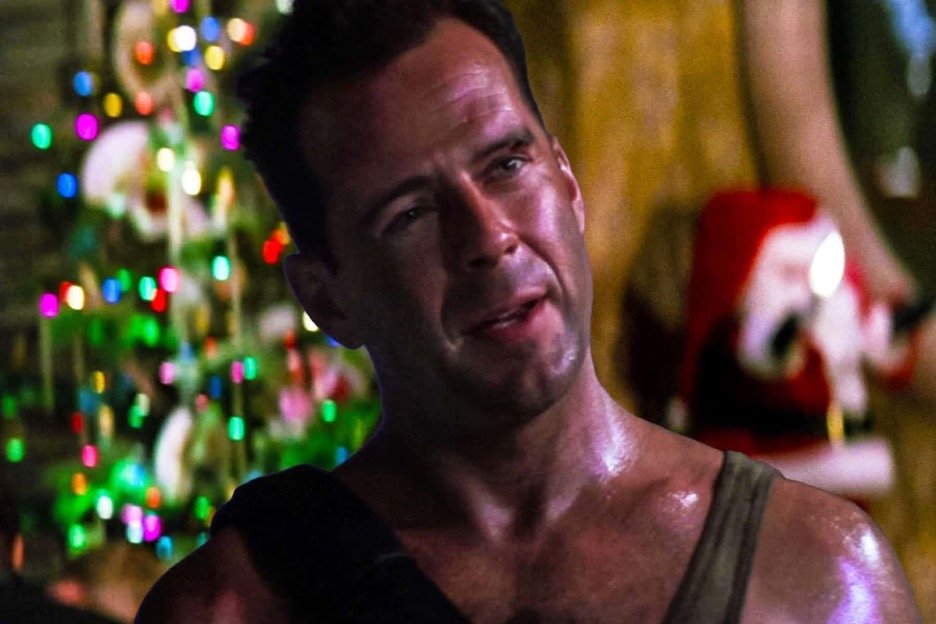
McClane is—at root—a gunslinger: trigger-ready and willing to shoot anyone who crosses him. As a gunslinger, he makes the law. In the final moments of the film, McClane is out of ammo. Gruber says: “Still the cowboy, Mr. McClane. Well, this time John Wayne does not walk off into the sunset with Grace Kelly.” McClane replies brusquely: “It was Gary Cooper, asshole.” McClane has an extra gun strapped to his back and whips it out, chirping “Happy trails, Hans” before he fires.
In Die Hard, all the destruction is justified, and none of it is John’s fault. Nonetheless, he gets to shoot people dead and blow things up. This fantasy of mass destruction without consequence is part of the good guy mythology as it moves from the frontier landscape to an urban one. There is more to destroy in city landscapes; but also, the visuals of a film present a stark critique of city life and the damage a gun can do within it. The debris of urban life falls all around them – especially endless sheets of paper from the office building, cascading earthward like snow. Such images are spooky after 9/11 for those of us with memories of it happening for real. I address the real-life dangers of mediated cowboy vigilantism in my book Cowboy Apocalypse.
McTiernan originally saw the holiday setting as background and not the center of the plot: “We hadn’t intended it to be a Christmas movie, but the joy that came from it, is what turned it into a Christmas movie.” What kind of joy is that? The joy of revenge, perhaps? The joy of massive destruction? Maybe it’s the joy of evil men getting what they deserve at the hands of a contemporary gunslinger? While McTiernan’s hope was that Die Hard would read as a critique of capitalism, I fear it too readily comes across as a celebration of booms. The presumption, of course, is that action movies like Die Hard are harmless, and depictions of gun violence don’t contribute to the rash of real-life shootings we regularly see on America’s streets. Just in the past few weeks we saw the mass shooting at Brown University and another mass shooting in Sydney at a large Jewish gathering.
I have several friends who love watching Die Hard during this season and I am absolutely sure they all oppose gun violence, nonetheless several posted a meme today that made me catch my breath before I recognized the fictional Die Hard reference.
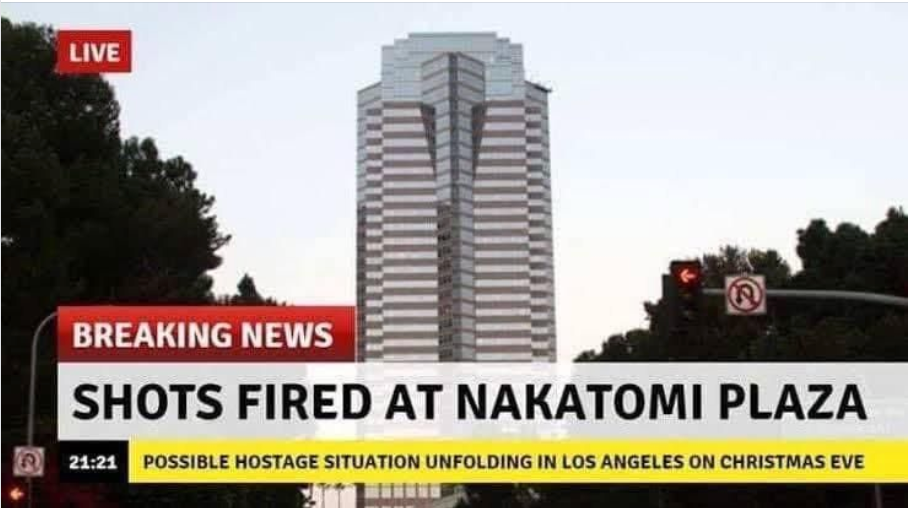
Nakatomi Plaza is a fictional location. But the idea that a hostage situation with “shots fired” could unfold at any moment is just American life. I shiver, thinking of the Twin Towers, of Oklahoma City, of violence in the Middle East and Ukraine. We’ve seen so many buildings reduced to rubble in recent years. Should we view the explosions and massive gunfire in films like Die Hard as harmless fun? My own take is that movies don’t make anyone violent. But they suggest, repeatedly, that guns are a simple way to solve complex problems. These movies reinforce the narrative so prevalent in American film and television that we need a cowboy messiah to save us: someone like Bruce Willis’s John McClane, a modern-day cowboy who will shoot his way to salvation.
The persistence of this narrative is one of the reasons so many people own weapons in America today. And as we all know, not everyone who thinks he’s a good guy really is one. Of course you should watch Die Hard on Christmas if you want. And of course movie guns aren’t real guns. But also ask yourself where the “joy” comes from in watching the film, and whether you really need explosions alongside your pie.
