on being human in trying times by Rachel Wagner
When my adult son went missing, I presumed him dead and my world collapsed. Then someone said: “You actually don’t know what’s going to happen.” My presumption exposed, I learned to stretch open the maw of possibilities. Despair broadened into awareness of a community of vibrant people all working on the same problem: How do we make space for the future we want? Ever since, I have been reading artists, theologians, philosophers, poets, scientists, feminists and others imagining a habitable future. I’ve discovered there are so many of us trying to figure out how to love one another better, and it’s been a salve to remember that.
In a world obsessed with violence and endings, it is easy to think that there is only a narrow band of possibilities for the future. Capitalism, fundamentalism, and demands for “productivity” tell us there isn’t much we can change. Hope is the means to activate other possibilities through real action in the world. I see hope having nine kin concepts that weave through each other. Each will be a chapter in a book I’m working on.
Uncertainty. We begin with what we don’t know. In her book Faith, Buddhist teacher Sharon Salzberg says that when suffering threatens to overwhelm her, she reminds herself of “what I am not seeing.” She says: “We don’t know the ultimate unfolding of any story; certainly not enough to decide that what we do has no effect. When we stand before a chasm of futility, it is first of all faith in this larger perspective that enables us to go on.” In his article “Hoping Against Hope: The Possibility of the Impossible,” theologian John Caputo defines hope as letting the future be uncertain. The “rational” part of us makes the most room for what is likely. Hope, however, makes room for the unexpected. Caputo says enigmatically: “To the extent that things make good sense, we do not need hope. To the extent that things do not make sense, we do.” The “impossible” is that which we do not allow could happen because we let others define what is “possible.” Caputo says hope is refusing to let presumed outcomes determine what could happen. He invites us to make room for the “possibility of the impossible,” by redefining for ourselves what is possible. For him, this is a form of faith.
Love. In her interview with marine biologist Ayana Elizabeth Johnson, Krista Tippett asks: “Could we let our love for all that we can save lead us?” Johnson is driven by her love for parrotfish and coral reefs. : “How do we build the future that we want to live in, where there’s a place for us and the people and the things that we love?” In All About Love, bell hooks says love is “taking responsibility” for our relationships, so that “in the face of barriers we still have the capacity to invent our lives, to shape our destinies in ways that maximize our well-being.” For hooks, love is “an action rather than a feeling.” We can choose to actualize it: “A love ethic presupposes that everyone has the right to be free, to live fully and well.” Love provides the determination to act even when we don’t know the outcome. It was this kind of love that had me sending boxes of coats to my son’s homeless community in Berkeley, keeping communication open to maximize possibilities. Hope gives us permission to open the aperture of possibilities and helps us determine what our work will be. Love provides determination to act even when we don’t know the outcome. Hope gives us the resolve to act toward the future we want. To find relief amidst uncertainty comes in holding onto what we love no matter the risks. Who and what do you love?
Imagination. This is where we dream big and tell fantastic stories of the future we want. Hannah Arendt says the present is not “determined by the future as such… but by…events which we hope for or fear.” Ruha Benjamin, author of Imagination: A Manifesto, says we should cultivate a “radical imagination” that “can inspire us to push beyond the constraints of what we think, and are told, is politically possible” Ayana Elizabeth Johnson says that we are “in this moment where imagination is one of the most valuable things we can bring to the table,” showing us “the spectrum of futures that are available to us.” By imagining the world we want, we give ourselves purpose. This excitation of imagination drives people in all professions to match their ideals with their disciplinary passions, imagining the future as not just what is expected to happen, but what is possible. It gives us a place to start. Benjamin asks: “Why be drawn into someone else’s fictional world when you could be living out dreams of your own?” Knowing who you are helps you know what you most want.
Interconnectedness. Our fates are entangled with all creatures on the planet. This is easy to forget in a time when human domination seems inevitable. Jane Goodall, in her Book of Hope, argues that humans are no more important than other animals, which also exhibit intellect and may be better than us at recognizing our place in nature. We are all in danger. She urges people to act from love for the earth despite the risks: “We can’t just think that we can do nothing and everything will work out for the best.” Poet Ross Gay reminds us in Inciting Joy that “no matter how hard you try, no matter how much you earn or stash or hoard or bunker up, no matter even your fleet of spaceships, you will never be self-sufficient or independent. Because nothing living is.” We are responsible to each other, not just ourselves. The future is most livable when we build it together.
Storytelling. Stories are the way we imagine new worlds. Ruha Benjamin describes what she calls the “Old Stories,” the ones “scripted by colonialism, capitalism, ableism, white supremacy, nationalism, and cis-heteropatriarchy.” All demand belief in “the inherent, God-given superiority of some groups over others.” Tyson Yunkaporta, author of Sand Talk, critiques colonial storytelling. Instead, he recommends “yarning,” an ancient Indigenous practice of telling stories to one another. Yarning involves “active listening, mutual respect, and building on what others have said rather than openly contradicting them or debating their ideas” (2020, 115). The goal of a yarn is “a set of understandings, values, and directions shared by all members of the group in a loose consensus that is inclusive of diverse points of view.” Yarning enables people to work together for a solution that emerges through interaction and through narrative. In an interview with Krista Tippett, adrienne maree brown (author of Emergent Strategy) says we should avoid “living inside of imaginations that other people told us were true and told us, this is how the world is.” Instead, we could embrace an “adaptive, relational way of being, on our own and with others.” brown wants us to “grow our capacity to embody the just and liberated worlds we long for.” What new stories can we tell that liberate the imagination? How can we tell these new stories together?
Attention. When we recognize, as Buddhist writer Joanna Macy (author of Active Hope) does, that “there’s not one particle in a cell of any organ, of our body or brain, that isn’t part of this world,” then we are drawn to “deep attention” and an appreciation for how everything relates to everything else. Mindfulness can be viewed as stepping outside of ordinary time and stepping into attention to one’s relationship with the world. We choose what to pay attention to. In World of Wonders, Aimee Nezhukumatathil suggests gently, “perhaps you could try a little tranquility, find a little tenderness in your quiet.” The world will respond with dancing frogs, the sun after rain, and a “landscape full of blue sky” and “cricket song.” As John Green remarks in The Anthropocene Reviewed, “aesthetic beauty is as much about how and whether you look as what you see.” adrienne maree brown says: “What you pay attention to grows.” What will you pay attention to?
Wonder. Wonder is related to wondering, the catalyst of curiosity. Wonder is hope infused with awe, a secular sublime that invites deeper relationship. Ross Gay is astonished by ice cream; startled by bees. When seeing something new, he asks: “What is this thing? How is it working? What is it showing us? How do we listen to it, and learn from it?…Wondering together again and again…like this, an endeavor of unfixing, of dismastery, of community-supported bewilderment, is the practice.” Wonder is the undoing of the self in encounter with the other. Wonder collapses the self and other into a surprising embrace. In Braiding Sweetgrass, Robin Kimmerer exults in the rainforest, pleading: “I want to be part of the downpour, to be soaked, along with the dark humus that squishes underfoot…I want to feel what the cedars feel and know what they know.” Her wonder and her curiosity are seasoned with desire, love, and hope for a world in which others share her devotion and want to “feel what the cedars feel.” How does wonder bind you to the earth and to life itself?
Joy. Ross Gay asks “what practices, habits, rituals, understandings—you know, the stuff we do and think and believe—make joy more available to us? What in our lives prepares the ground for joy?” Joy is a cultivated practice open to anyone. Gay sees joy as “an ember for or precursor to wild and unpredictable and transgressive and unboundaried solidarity.” Joy can “depolarize us and de-atomize us enough that we can consider what, in common, we love.” Audre Lorde says in “Uses of the Erotic” that the sharing of joy “forms a bridge between the sharers which can be the basis for understanding much of what is not shared between them and lessens the threat of their difference.” Joy evokes belonging, urging us toward the world we want. To feel joy is not to abandon the fight for justice. Rather, it is to sink into the reasons for seeking it. Ross Gay says joy can “depolarize…us [so that]… we…consider what, in common, we love.” Audre Lorde says joy is “a bridge” that “lessens the threat of [our] difference.” What brings you joy? It will guide your actions and your imagination.
Repair. Eventually my son did come home. But hope offers no guarantees. It simply widens our view of what’s possible. Hope is often misunderstood as the presumption that everything will turn out just swell. The reason to act toward a better future—to hope—is not because we can fix the outcome, but because we love the world. Hope gives you room to believe things might not turn out in the worst way and to widen your view of what is possible. Kin concepts provide the ground we can stand on whether things work out well or not. A student told me hope’s what-if saved her when her best friend disappeared. She sat with I-don’t-know and just kept breathing. I-don’t-know makes room for life beyond the inconceivable. The opening applies to any catastrophe, small or large. The uncertainty of hope is a gift. We might die in apocalyptic fire. But also: we might learn to love each other. We might destroy the earth. But also: we might learn to live in better balance. Imagining the future we want gives us space to move toward it. You’re not alone in imagining something better. Hope fuels the sense of purpose and motion that urges us to act, considering that care. We might survive. We might begin repair. And if we are fueled by love, the odds go up.
Hope makes room for life beyond the inconceivable. Hope is not optimism. It is a set of practices for cracking open the way to a better future.
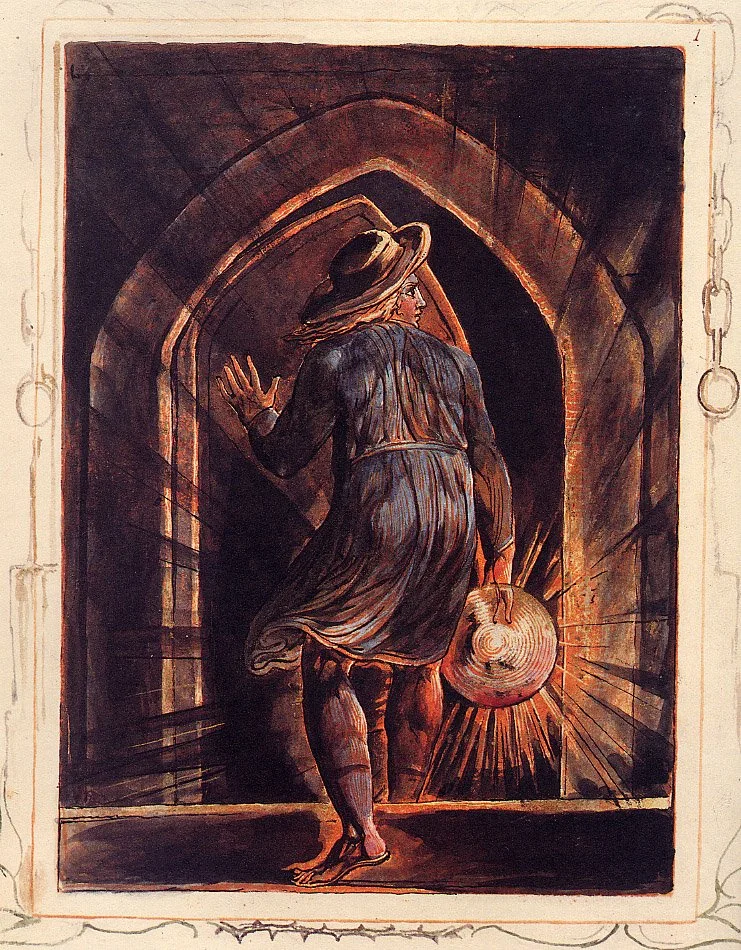
William Blake, Plate 1, Jerusalem.
